
Part 2 of The three words that will almost certainly change your life.
A multidimensional (and revolutionary) approach to true freedom, clarity, and creative awakening.

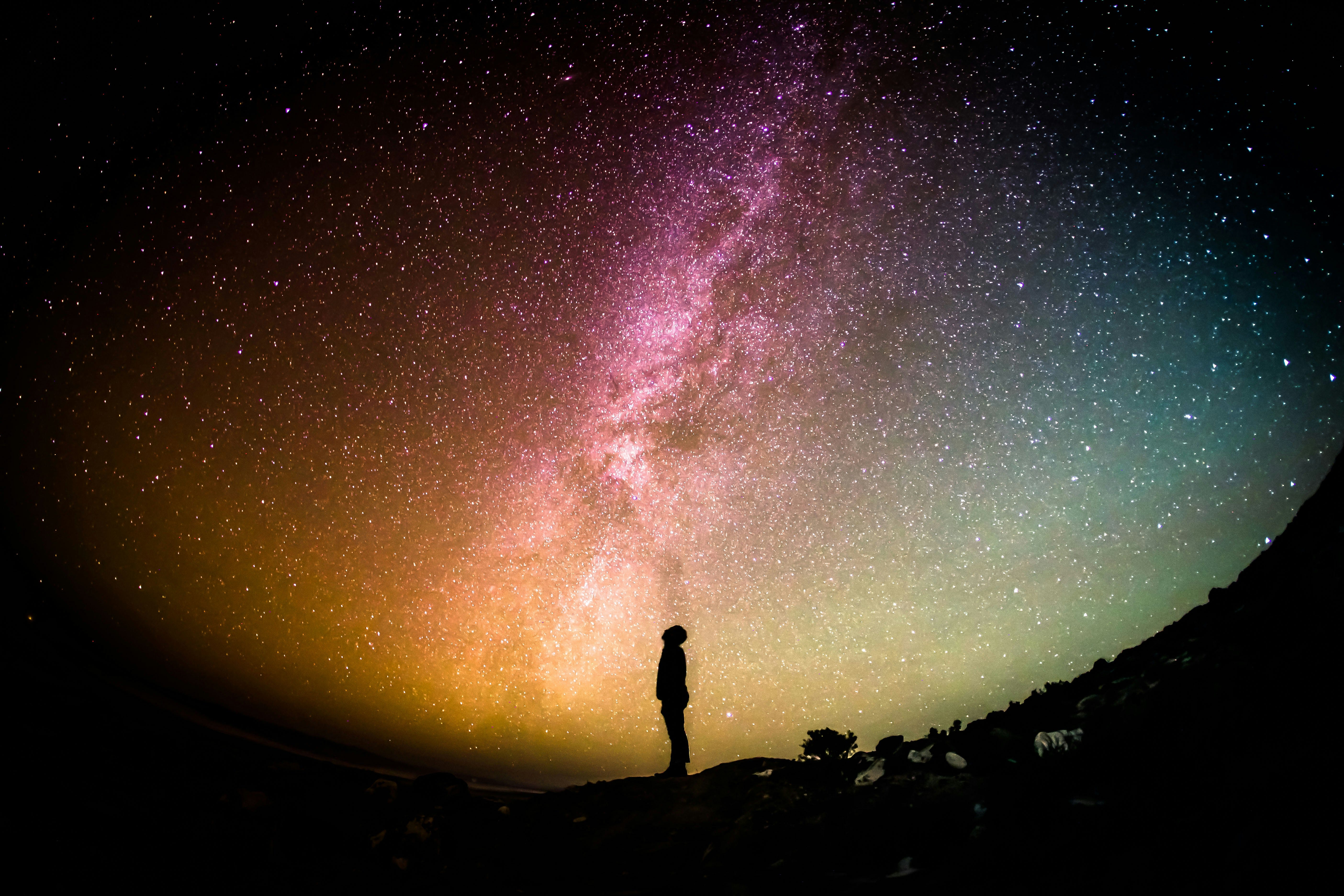
Photo by Greg Rakozy on Unsplash
*Audio version
Part 2: The Way of Unknowing
Today I want to reflect on three simple words that have the power to consistently break open our interior world in surprising ways.
In Part 1, I explored how we each carry a very limited version of reality - a little universe of beliefs, assumptions, and self-concepts shaped by our experiences and environments, often driven by an unconscious need for security.
Yet regardless of how experienced, intelligent, or intuitive we may be, we can never see the full picture of our lives. We don’t fully understand who we are capable of becoming, nor do we know precisely how to get there.
A flourishing life is full of healthy tension, and this may be the most fundamental of them all: On one side, we recognise the importance of taking responsibility for our lives: drawing upon our gifts, intelligence, and opportunities to live with purpose and integrity. Yet at the same time, we’re asked to hold all of this effort within a larger posture of surrender - an acceptance that we don’t truly know what’s best, and a willingness to rest in that mystery even as we act within it.
The awakened pilgrim
There’s a story from the Buddhist tradition of a master who asked a passing pilgrim where he was off to.
“I’m on pilgrimage,” the pilgrim replied.
“What sort of thing is pilgrimage?” the master asked.
“I don’t know,” said the pilgrim.
To which the master responded, “Not knowing is most intimate.”
And upon hearing these words, the pilgrim had a great awakening.
This story captures what happens when the world of knowing begins to give way. The moment we admit “I don’t know,” we cross the threshold we met in Part 1 - from the small universe of understanding into the vast field of intimate knowing.
The three words: I don’t know
At the heart of this two-part reflection lie three life-altering words - simple yet revolutionary: I don’t know.
Even though I have desires and ideas about what I want and what’s best, the truth is that I don’t really know what is most true, most important, or where my life is ultimately leading.
It takes a fair amount of consciousness and inner security to truly entertain this idea. But when we do, these simple words help us transcend the limits of our understanding and begin drawing from a deeper, more primal form of intelligence.
The acceptance of our not knowing - and our ability to rest in it - is the gateway to the knowledge that ultimately matters.
The Christian mystic John of the Cross, who gave us the image of the dark night of the soul, noted that in unknowing - which for a time, can feel deeply disorienting and even bewildering - we can discover a new illuminance: a deeper connection and understanding that changes everything.
In spiritual circles, this posture is sometimes called beginner’s mind: a fundamental stance of humility towards life, a readiness to lay aside what we think we know in order to observe, receive, and learn. We think we know what a tree looks like, but do we really? Beginner’s mind opens us to a broader, deeper, richer experience of reality.
Throughout the world’s spiritual traditions, the path of unknowing has constantly been the birthplace of transformation. Few stories capture this more vividly than that of Abraham, called by God to leave behind all that was known - his homeland, his security, even his sense of self - and to walk toward a future beyond the reach of his own understanding. With every uncertain step, something larger began to move through him. In surrendering his certainty, he became the doorway through which a whole new life entered the world.
A different kind of intelligence
Beneath the limits of reason lies another kind of knowing - a soul intelligence the rational mind can’t access, yet the deeper self recognises instantly.
The language of the soul is right-brain. It emerges through paradox, metaphor, and narrative. Soul intelligence doesn’t arise through effort but through a deep desire to understand and a trust that what we need to know will surface in its own time.
In the story above, the master was suggesting that not knowing is not a gap in our awareness, but an intimate part of experience. It’s a portal into a deeper kind of knowing - which, of course, sounds like a paradox to the rational mind.
The way of unknowing is ultimately a way of trust.
When I don’t know, I’m recognising that I’m not supposed to work it out on my own - in fact, I can’t. But there is something, or Someone, I can access, who does know.
This humility marks the beginning of our graduation from egoic consciousness to soul consciousness.
A genuine, conscious “I don’t know” dethrones the perspectives I’ve been attached to and softens the egoic barrier that separates me from the greater intelligence of my true centre - what we might call God, Spirit, or Universal Consciousness. Accepting our unknowing creates space for a greater wisdom to emerge.
This is perhaps the ultimate surrender we are invited into as humans - and also the most fruitful one. I want to suggest that this is also the essence of spiritual practice: what it looks like to have embodied ‘faith’ in God.
Over time, unknowing doesn’t just humble us, it frees us. It loosens the grip of self-importance and opens the creative currents of the soul. What once felt like disorientation becomes the birthplace of imagination and a whole new realm of possibility.
The promise of the great spiritual traditions is that when we cooperate with this deeper intelligence and trust its prompting (even when that feels destabilising - which it usually does), we enter a level of congruence and soul-alignment that is liberating, expansive, powerful, and grounding all at once. This alignment reveals new ways of understanding ourselves, our purpose, and the world. It gives us reasons for hope and cultivates a deeper trust in life itself.
A word about timing
One of the most humbling lessons in spiritual, or inner growth, is that we cannot hurry it. Transformation unfolds in its own rhythm, often slower than we would choose. We simply need to jump into the river of life as authentically as we can and allow it to lead us through various thresholds when we are ready.
This is especially true when it comes to our relationship with unknowing. In a sense, we need to wait for the invitation to embark on this path, because we need sufficient inner resources to walk it without being dismantled by it.
Often this invitation is precipitated by disappointment, suffering, or unexpected change - experiences that confront us with the limits of our understanding and effort.
When that invitation to lean into the unknown does come, it usually arrives with resistance. A big part of us does not want to accept that we don’t know, because it can feel so unsettling. To be honest, I even felt a little vulnerable after publishing Part 1 of this reflection, because it brought me so close to the reality of my own unknowing.
By saying these three words, we’re moving away from the psychic structures that once made us feel safe - and that can feel threatening. But it’s only the ego that feels threatened, sensing that it’s being dethroned as ruler of our life - a necessary task if we are to truly flourish.
My experience in the unknown
In recent years, life has carried me into a profound season of unknowing - one that has been essential to my own evolution and fruitful in ways I could never have planned or imagined. I’ve been learning, sometimes awkwardly, how to allow it: how to sit with uncertainty rather than rush to resolve it, how to make space for the darkness without trying to fill it with answers.
Bit by bit, I’ve begun to notice the faint light that flickers within it - a deeper illuminance that quietly, and sometimes insistently, guides the next small step. Trusting that light has become its own kind of practice, which has opened me up to so many signs, synchronicities, and timely encounters. All of these seemingly ‘random’ experiences have been quiet encouragements to keep going, to keep trusting the path of soul.
And in those moments when I take even a small step forward in the dark, life itself feels more vivid - love, beauty, kindness, and even pain take on new texture and meaning. When we loosen the grip of our familiar understanding, we make space for a whole new way of seeing and experiencing.
A few practices
Even if we deeply resonate with these ideas, it’s quite likely that upon finishing this reflection we will return to our normal mode of existence. Our patterns are deeply ingrained and require intentional practice to shift.
So if you sense that you’re being invited to embrace more of the unknown, here are some practices that may help you respond. Have a go at some of them, and see how they land for you.
Hand it over.
When you’re wrestling with a question or situation, remind yourself that your understanding is limited and pushing harder won’t help. Hand the situation over to your deeper intelligence, to the greater consciousness that many of us call God. Trust that it knows what to do, and actively wait and listen for its response.
Spend some time meditating with this exchange.
Q: Where are you going?
A: I don’t know.
Sit in stillness and notice what you experience as you accept that you don’t know where you’re going.
Seek awe.
Spend time in environments that evoke awe — the ocean, the stars, art, animals, music, or natural beauty that stirs your heart. Awe confronts us with the limits of our understanding while reminding us of a greater power at work — one that is fundamentally good.
From time to time during your day, ask yourself, “What if I don’t know?”
Just allow this question soften your certainty, to invite you to a deeper place.
Reflect on these words by T.S. Eliot:
“I said to my soul, be still and wait without hope, for hope would be hope for the wrong thing;
wait without love, for love would be love of the wrong thing;
there is yet faith, but the faith and the love are all in the waiting.
Wait without thought, for you are not ready for thought:
So the darkness shall be the light, and the stillness the dancing.”
Closing reflection
At some point, we all reach the edge of our maps - the place where knowing stops working and only trust will do.
If you can stand there - awake, available, and honest - repeating those three simple words, I don’t know, you may find they open more than they close. They don’t end your journey; they begin it again, this time from the soul - where not knowing becomes its own kind of knowing.
I’d love to hear any thoughts this reflection may have stirred in you - you can comment below. And if you know someone who might benefit, feel free to share this with them
— Dan.
Hey Dan, I really enjoyed this essay. In my work I use the analogy of containers and spaces so that my clients can feel shapes & ‘architecture’ within the unknown. At the beginning of a transformative experience, structure helps them orientate; it gives form to what feels formless. But as time moves on, the containers fall away and they begin to rest more easily in the space itself, in the ether, in the vastness of the unknown. That is where the true magic happens because when we let go of the known we finally let in the universal laws and spiritual truths that govern everything. They learn then to become who they were always meant to be. I wrote a note yesterday about how the containers are like doorways to our consciousness. And as you say, stating aloud ‘I don’t know’ can feel so uncomfortable at the beginning. Until they get comfortable in the uncomfortable. With faith as the foundational feeling, the platform if you will that can give you a sense of standing in the unknown or another way to say it a solid base to stand on even though that’s an oxymoron as you’re not standing on anything. I’m going to part one now!